How to use our platform?
Explore our quick guide to using the UAVConnect platform. If you have any questions, we’re here to help.
The European Cluster for Drone Innovation (ECDI) has officially completed the selection process for the first cut-off of its Open Call “The Civil Drones Innovative Programme”.
ECDI is a Eurocluster consisting of a strong and complementary consortium of Aerospace Valley (Coordinator), Andalucía Aerospace Cluster Empresarial (Environment), Silesian Aviation Cluster (Communication & Network), All-Ukrainian Association of Innovative Space Clusters (Dual-use).
The project aims to strengthen Europe’s leadership in drone technologies for civil and dual-use applications. ECDI stands out as the only Eurocluster initiative fully dedicated to UAV technologies, dual-use solutions and drone-driven advanced innovation.
This first call has confirmed the growing interest of European companies in innovative solutions applied to drone technologies. The selected companies represent a diverse range of the civil drone and dual-use technology sectors.
Applications were received from more than 24 EU Member States and 3 COSME countries, and the Programme recorded:
● 134 completed applications
● 111 administratively eligible applications
● 99 projects technologically evaluated
● 13 selected European SMEs
These results demonstrate both the attractiveness of the Programme and the high level of competitiveness of the submitted projects.
The selected companies come from several European countries, including: Cyprus, Croatia, France, Greece, Italy, Lithuania, Poland, Turkey and Ukraine.
Following the selection process, participating companies have already taken part in an onboarding and introduction meeting, during which they presented their projects and met the mentors who will support them throughout the Programme. The coming weeks will be dedicated to the operational launch of projects and the gradual presentation of innovative solutions developed within the Programme.
The Programme provides selected SMEs with:
● dedicated mentoring,
● innovation and dual-use transition support services,
● personalised assistance,
● collaboration and networking opportunities.
The ECDI consortium wishes to thank all companies that participated in this Call for the quality of their applications and their contribution to the dynamism of European innovation.
A second cut-off of the Open Call is currently open for applications, offering additional SMEs the opportunity to join and benefit from the Programme. Innovative European SMEs wishing to join the Civil Drones Innovative Programme — including those not selected in the first wave — are invited to apply or reapply before 15 June at 5:00 PM CET.
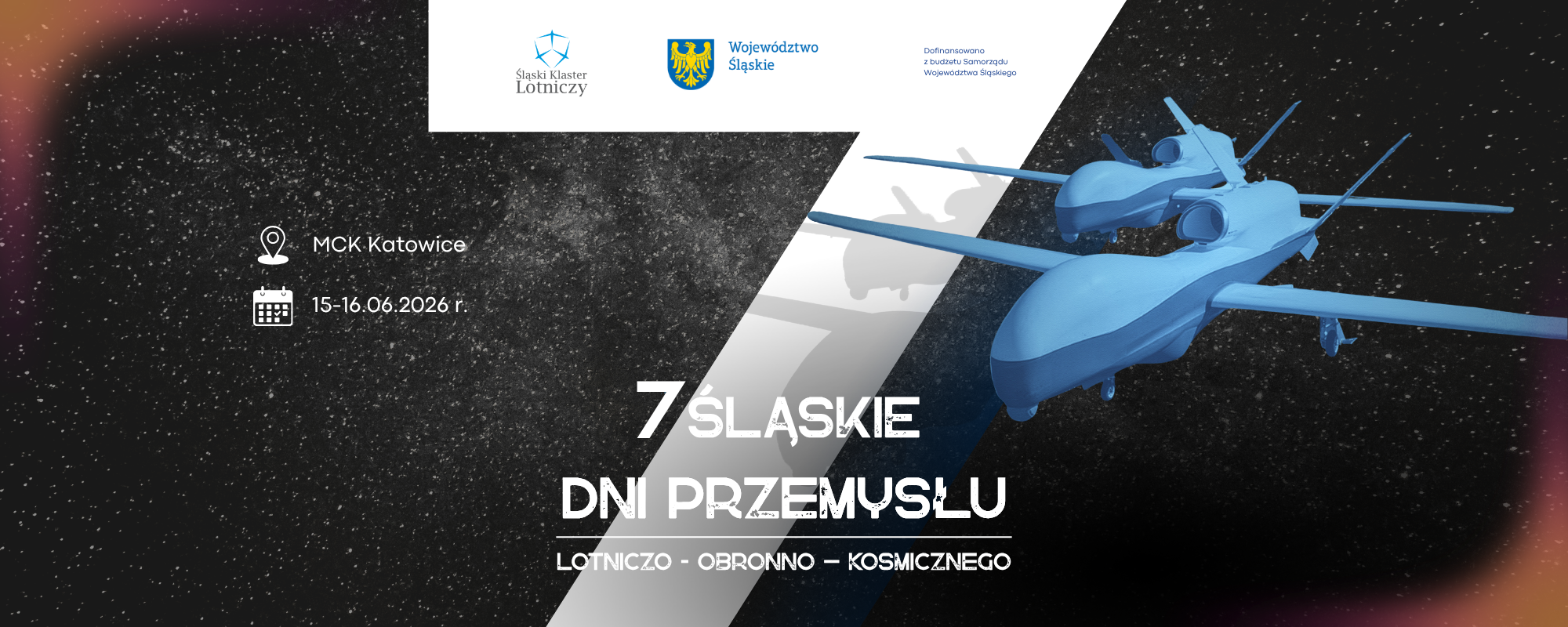
We are thrilled to announce the upcoming 7th edition of our flagship event. The VII Silesian Aviation-Defense-Space Industry Days will take place on June 15-16, 2026, at the International Congress Center (MCK) in Katowice.
This year’s edition marks a strategic milestone, evolving from the well-regarded “Silesian Aviation and Drone Days.” Our new, expanded formula is a direct response to dynamic market shifts and the vital synergy growing between the civilian, defense, and space sectors.
We are taking it a step further by hosting this edition as a side event to CYBERSEC EXPO & FORUM 2026. This strategic partnership creates a unique intersection between aerospace engineering and digital security. In an era of Unmanned Aerial Systems (UAV) and satellite technology, cybersecurity is no longer an option—it is the foundation of modern aviation.
Our conference program guarantees high-level knowledge sharing. We are honored to host distinguished speakers, including:
Col. Wojciech Prokopowicz – Ministry of National Defense, Minister’s Office (tbc)
Dr. Eng. Łukasz Kiszkowiak – Military University of Technology (WAT) (tbc)
Col. Prof. Mariusz Zieja – Air Force Institute of Technology (ITWL) (tbc)
At the Silesian Aviation Cluster (ŚKL), we aim to build lasting bridges between industry leaders and the R&D sector. We believe that by working together, we can act better, faster, and more effectively. This event is a premier space for building the commercial and strategic partnerships that drive the global competitiveness of Polish aviation.
Join Us! We invite industry representatives, researchers, and technology enthusiasts to participate in this exceptional venture.
🔗 Registration and detailed program: https://7slaskiedni.aerosilesia.eu
Stay tuned!
Join the Dual Use Congress 2026 – a platform for dialogue between business, government, and the defense sector.
The Congress is dedicated to dual-use technologies, which are playing an increasingly important role in both the economy and national security systems. Its goal is to create a space for dialogue and develop directions for cooperation between the public and private sectors. The Congress will bring together representatives from government, the defense sector, and industry.
📅 May 27, 2026
📍 Poznań Congress Center (Poznań International Fair)
The program includes:
– the development and implementation of dual-use technologies in the economy and defense sector
– building an ecosystem of cooperation between industry, science, and government
– financing innovation and access to support tools
– regulatory and strategic market conditions
The program has been designed to cover the entire project development cycle: from strategy, through financing, to implementation and operational challenges for companies.
During the Defence24 Days event, dedicated to security and defense, one of the most important defense-related events in Central and Eastern Europe, a panel was held with Krzysztof Krystowski, President of the Silesian Aviation Cluster. The panel was titled “Integrated Drone Defense System.”
The discussion made one thing clear: modern threats require not isolated solutions, but full integration of defense systems.
Drones and unmanned aircraft have become a real challenge for national security, critical infrastructure, and air defense. Experts emphasized that today, not only combating threats but, above all, their rapid detection, reconnaissance, and effective warning is crucial.
During the discussion, it was emphasized that drones are increasingly being used to overwhelm defense systems. In this context, it is particularly important to properly differentiate the level of threats—from small objects to unmanned systems capable of causing significant strategic impact.
One of the key conclusions of the panel was the need to build an integrated reconnaissance and warning system. Early warning and reconnaissance aircraft can observe and track thousands of objects from long distances, transmitting data to ground-based air and missile defense systems.
The President also offered an apt metaphor: defense without a central system is like turning off the lights and trying to find the threat blindly. An integrated early warning system, on the other hand, is about “turning on the lights” – creating a complete picture of the situation and enabling an effective response.
The discussion demonstrated that effective defense against drones today requires a comprehensive approach, the cooperation of various systems, and prioritizing the protection of human life and strategic infrastructure.
The following experts participated in the discussion:
- Colonel Dariusz Huryń
Inspectorate of BSU Forces, General Command of the Polish Armed Forces - Tomasz Kieć
Head of the Business Development Office, Sales and Programs Division, Polskie Zakłady Lotnicze – PZL Mielec - Krzysztof Krystowski
Country Director of Northrop Grumman Poland S.A. - Balázs Nagy
CEO and Co-Founder of TYTAN Technologies - Maksymilian Szuba
Chief Operating Officer of UMO
China’s doctrine regarding long-range strike drones underpins the concept of so-called intelligent warfare, in which artificial intelligence and autonomous systems become a decisive factor on the battlefield. Instead of treating drones merely as support for traditional units, China’s strategy involves creating autonomous systems capable of breaching enemy defenses as part of an anti-access strategy.
Like many other countries, the Chinese have recognized the potential for quantity to quality, where inexpensive weapons can saturate enemy air defenses, making them impossible to effectively combat not through the quality of air attack assets, but through sheer quantity. However, China does not plan to use long-range drones in the same way as Russia. Russia permanently employs them as the primary means of attack against selected targets. A key element of this approach is leveraging numerical and cost advantages, as manifested in plans to use mass drone swarms to physically and economically exhaust enemy air defense systems. In Russia, however, attacks on civilians and energy targets continue using a plethora of cheap drones, mass-produced under Iranian license in the city of Alabuga, Tatarstan. These are primarily Shahed drones, known by their Russian name Geran. Various improvements are being introduced, such as improved navigation systems, increased-power warheads, and the ability for remote control by an operator using the local internet thanks to SIM cards purchased from various countries with Russian roaming. This is a cheap and simple method; a broadband satellite connection is not necessary…
In China, however, there is a division; Chinese doctrine is more sophisticated. Cheap, simple drones are merely decoys, deployed en masse in the first wave. They are used to force air defenses to fire anti-aircraft missiles, maximizing their efficiency. They can be used in multiple successive waves, allowing the enemy to launch not only the missiles currently on launchers but also those stored in batteries, so that subsequent missiles would have to be brought in from more distant warehouses or bases.
Only then do the proper radar-detection-resistant systems come into play. The Chinese have developed a special GJ-11 “Sharp Sword” (Lijian) drone, one of the most advanced unmanned aerial vehicles in China’s arsenal, designed as a “stealth killer” for deep penetration missions. Its flying-wing design allows for a drastic reduction in radar signature (by up to 90% compared to standard drones), enabling it to operate in heavily defended airspace. Its wingspan is approximately 14.4 meters, and the aircraft is 12.2 meters long. Equipped with a single turbofan engine (likely a WS-13 without afterburner), it can reach subsonic speeds of around 1,000–1,100 km/h. The estimated operational radius is over 1,500 km, allowing for operations within the “first island chain.” The total flight range can reach 4,000 km, and the airborne time is approximately 6 hours. It has two internal bomb bays, which is crucial for maintaining stealth characteristics. The total armament load is approximately 2,000 kg. It can carry up to eight precision glide bombs (e.g., FT-5) or anti-radiation missiles and air-to-surface missiles.
Zdaniem tych aparatów jest utorowanie drogi dla lotnictwa pilotowanego oraz dla kolejnego typu: nosiciela małych dronów FPV do wykonywania wielu ataków na liczne cele, na niemal dowolną odległość. Chińskie podejście do nosicieli dronów FPV (First Person View) to obecnie jeden z najbardziej dynamicznie rozwijających się elementów ich doktryny, czerpiący bezpośrednie lekcje z konfliktów na Ukrainie i Bliskim Wschodzie. Chiny nie budują jedynie samych dronów, ale całe ekosystemy – od gigantycznych “latających lotniskowców” po lądowe stacje bazowe. Najważniejszym projektem w tej kategorii jest Jiu Tian („Dziewięć Niebios”), który odbył swój dziewiczy lot pod koniec 2025 roku. Jest to 16-tonowa maszyna odrzutowa o ogromnym udźwigu (do 6 ton uzbrojenia i wyposażenia). W centralnej części kadłuba Jiu Tian posiada modułową komorę zdolną do przenoszenia i wypuszczania w locie ponad 100 mniejszych dronów. Dzięki temu tanie drony FPV, które normalnie mają zasięg zaledwie kilku lub kilkunastu kilometrów, mogą zostać przetransportowane głęboko za linię frontu i tam uwolnione do ataku saturacyjnego (rój).
Chińskie zróżnicowane podejście do wykorzystania mieszanej floty aparatów bezpilotowych różnych typów oraz o różnym stopniu złożoności jest bardzo różne od rosyjskiego. Jest bardziej elastyczne, bowiem pozwala dopasować sposób ataku do sytuacji, a głównie do kondycji obrony przeciwlotniczej przeciwnika.
Michał Fiszer together with Maciej Herman
The change in commander of the Aerospace Forces prompts us to ask: why can’t Russia cope with cheap Ukrainian drones? This seems to be the reason for his dismissal—the fact that Russia is taking heavy hits from the air.
The Russian air defense system was considered the strongest in the world, rivaled only by China’s. This is primarily because the Americans haven’t developed a traditional air defense system on their own territory. Currently, NORAD operates exclusively with fighter jets. Typically, 14-16 locations in the continental US (CONUS) are on permanent, 24/7 duty, with additional locations in Alaska and Hawaii. This number fluctuates slightly depending on the current threat assessment and the Pentagon’s budget. In Poland, our two pairs of on-duty fighters are sufficient, so our QRA duty covers an area four times smaller than in the US. Additionally, the US has no anti-aircraft missile units in positions around cities, while Russia and China do. Russia has twice the number of fighter jets on duty per square meter of the European part of the country, and most major cities are also protected by anti-aircraft missiles.
Of course, it’s impossible to defend everything, but the saturation of air defense assets and fighters is quite high. Theoretically, any cheap drone in use in Russia can be shot down with relative ease by any anti-aircraft missile, within its full range and altitude. This is truly no problem.
So why can’t Russia deal with them? Why are refineries, oil and fuel terminals in ports, fuel depots and tanker depots at stations still burning, and why are arms factories and other important facilities being hit? How is it that Russia is unable to defend itself with such strong anti-aircraft defenses?
A Ukrainian mobile anti-drone group, a vehicle with the heaviest 12.7 mm machine gun and a gunner; the other members of the group are not pictured.
This isn’t just about the traditional Russian bardak. The Russians failed to grasp one crucial point: cheap drones, while easy to shoot down, are also easy to mass-produce. That they can be deployed in significantly larger quantities than anti-aircraft missiles. Therefore, defending against drones requires developing special methods, special weapons, and special tactics. This doesn’t fit the usual framework of classic anti-aircraft defense. You can’t do things like the Americans, who fired several years’ worth of Patriot missiles at cheap Iranian drones in two months.
The Russians responded with a second change of command in a short period of time. None of them were pilots, which is standard practice in the Air Force worldwide. Sergei Surovikin is a typical post-Soviet slacker, hailing from mechanized forces. He had no idea about the Air Force, aviation, or air defense; he was supposed to clean up the mess, get rid of the slackers, and curb corruption. That didn’t work out, so in 2023 he was fired, not for being a slacker in the VKS, but for his ties to Prigozhin after his infamous mutiny. The next one, anti-aircraft officer Colonel General Viktor Afzalov, was definitely better, but he was also old-school. He didn’t understand what was happening, why these cheap drones were flying everywhere, even though the guys were shooting them down by the thousands—how much could you do? He clearly didn’t grasp the paradox of Schrödinger’s cheap drone, which you can “kill” by the thousands and still survive. And the missiles are running out… And now he’s swapped his axe for a stick. Another “mechanized” general, Alexander Chaiko, was appointed commander of the VKS on May 4, 2026. But there’s more. General Chaiko commanded the main assault on Kyiv, from Belarus via Chernobyl, Ivankovo, Irpin, and Borodianka, completely crippling the operation. In fact, Vladimir Putin can thank him for why the operation, planned for a maximum of two weeks, is now in its fifth year.
The primary Russian anti-aircraft system for destroying drones is the Pantsir S1, deployed behind multiple targets. However, it is unable to cope with a massive wave of attacking drones.
The solution, however, is the same one the Ukrainians have adopted: they have created an independent anti-drone defense system. It consists of hundreds of mobile and as many stationary anti-aircraft groups, armed with inexpensive weapons such as machine guns, but also new interceptor drones, which are as cheap as attack drones and can therefore be fired at them by the thousands. While not as effective as anti-aircraft missiles, they can be used en masse with excellent effect. Russia needs to build all this, but at this point, it’s already two years late.
Michał Fiszer, with Maciej Herman
Reports from Ukraine increasingly mention the widespread use of unmanned ground vehicles with weapons, intended to replace human soldiers. Is this even possible today?
Ukraine uses numerous unmanned ground vehicles. Primarily, they are used for logistics. Resupplying in an environment of widespread UAV use has become a serious problem. A distance of zero to approximately 20 km from the front edge of friendly forces is a so-called kill zone. The probability of an FPV drone hitting someone who is not concealed, stationary equipment, or even moving vehicles is high. It is not uniform across the entire zone; near the front edge, it is almost 100%, but it decreases with distance. Within 15-20 km from the front, veterans estimate the probability at around 25% on the main front lines. It is, of course, lower on secondary front lines. Therefore, unmanned ground vehicles are excellent at supplying troops. It’s a known fact that a truck doesn’t get you to the “drone death zone.” Until now, soldiers carried everything needed on the front, primarily ammunition and food rations, on their backs, weighing 10-15 kg each, for distances of 10-20 km. As you can imagine, they had to make numerous such “trips,” which was particularly dangerous, as enemy drones hunted them. Replacing them with vehicles with a load capacity of 200 to 500 kg, remotely controlled by radio, allowed for an increase in the volume of supplies delivered to troops, reduced the number of trips, and importantly – hitting such a vehicle doesn’t result in death. Equipment can be manufactured, but a soldier can’t be brought back to life. Moreover, given the challenges of mobilization, human life also has a purely practical dimension.
For this very reason, Ukrainians are pushing for the introduction of an increasing number of unmanned combat vehicles. They most often take the form of small tracked vehicles, which have long been used by sappers to remove improvised explosive devices from areas where their detonation could pose a threat, or for other similar tasks. Instead of a gripper and manipulator arm, they are armed with a machine gun or grenade launcher, with an appropriate ammunition supply. However, other vehicles with greater cross-country capability or simply faster are also available, as Ukrainians are also experimenting with wheeled vehicles resembling small off-road vehicles.
The most popular combat robot in the Ukrainian military, the Devdroid Droid, is armed with a 7.62 mm or 12.7 mm machine gun, depending on the version.
The most popular unmanned combat vehicle, also known as a battlefield robot, is the Devdroid Droid TW 12.7 and its slightly smaller variant, the Droid TW 7.62. As you might guess, the number denotes the caliber of the vehicle’s machine gun. They are built on tracked chassis similar to those of engineer robots with electric drive. The main wheeled system is the 300-kilogram Ljut (fury), with an electric 4×4 drive and a small rotating turret housing a 7.62 mm PKT machine gun. It has a speed of 12 km/h and a battery sufficient for a range of about 30 km (three hours at about 10 km/h). The droid, of course, moves slower, but has a similar range. Both can operate for up to 36 hours in standby mode without moving, with the camera on; with its mechanical rotation, this time is obviously shorter. The direct communication range with both types is 2 km, but in practice, in terrain full of obstacles, the range drops to about 700 m. This is enough to control such a vehicle from a hidden position and conduct combat remotely.
However, this is where the problems begin. First of all, the aforementioned robots are not as agile as a human. They move clumsily, and the operator must be careful not to get stuck somewhere, in a hole, on wet ground, or on an obstacle. The reaction speed to incoming aerial drones is practically nonexistent. While a human can dodge, hide behind a tree, jump into cover, into a building, or a dugout, An unmanned aerial vehicle (UAV) cannot do this, so losses from flying drones are much greater than those of human soldiers. Furthermore, the camera’s field of view is very limited. We don’t realize that our eyes can see so much simultaneously. The correct binocular field of view is wide, approximately 180°–200° horizontally and approximately 130°–135° vertically. It’s crucial to distinguish between acute central vision (small angle) and peripheral vision (wide, weaker vision). However, peripheral vision causes something to catch our attention and we turn our head to take a closer look. A robot’s camera cannot do this; its field of view is much smaller, making it more difficult for the robot to observe the battlefield and respond to threats. Humans also have other senses, for example, hearing, which allows for quick danger detection.
The Lyut (Ukrainian: “Fury”) from UGV Robotics is a Ukrainian, robotic, mini-tank-class unmanned ground vehicle (UGV), designed for combat and support missions.
Therefore, when it comes to occupying and controlling terrain, unmanned ground vehicles are still significantly inferior to human beings and are essentially incapable of replacing infantry in their normal activities. However, they can be very effective as mobile fire support for infantry. Such robots significantly enhance the firepower of “bio-infantry,” and the firing robot does not reveal the soldier’s location. This increases the firepower of the attack, but simultaneously reduces the exposure to detection and fire of human soldiers, who conduct much more effective surveillance and can quickly retreat to safety.
Therefore, what we can consider the near future is a mixed formation of “human” and “mechanical” infantry, where ground robots will provide effective support to soldiers, but will also facilitate reconnaissance and check human crossings for mines and other traps. Other robots will help supply this infantry, and still others will assist in medical evacuations.
Michał Fiszer, with Maciej Herman
A representative of the Silesian Aviation Cluster Joanna Wagner showcased the European Cluster for Drone Innovation (ECDI) and the Innovation Drone Alliance (IDA) during XPONENTIAL Europe 2026 in Düsseldorf.
As one of Europe’s leading events for autonomous systems, robotics and unmanned technologies, XPONENTIAL brings together the entire international community to explore the future of innovation across air, land, maritime and space.
During the presentation, we had the opportunity to share the vision, objectives and impact of ECDI, as well as highlight the role of IDA as a future European network connecting drone stakeholders across borders.
The Civil Drones Innovative Programme, implemented under the ECDI project, has officially launched its Open Call targeting European manufacturing SMEs active in the drone sector.
The Programme aims to support SMEs developing innovative civil and dual-use drone technologies, by fostering the technological maturation of their products and strengthening their innovation strategies.
Selected SMEs will benefit from:
• personalised support (mentorship, tailored services and training),
• financial support of up to €50,000,
• access to a European ecosystem of experts and specialised partners.
Each selected SME will implement an Innovation Plan, which will guide the technical and strategic activities carried out within the Programme.
📅 Open Call launch: 15 January
🗓️ Two cut-off dates are foreseen:
• Cut-off 1: 16 March 17.00pm CET
• Cut-off 2: 15 June 17.00pm CET
Applications are submitted online via the dedicated platform. Detailed information on eligibility conditions, application procedures and evaluation criteria is available in the Guide for Applicants.
👉 Apply on line
🔗 For more info : Guide for Applicants.
We are excited to be a speaker at the upcoming EU Clusters Talk: Joint Cluster Initiatives – Presenting the new Euroclusters (Strand 2) webinar, organised by the European Cluster Collaboration Platform (ECCP) on 14 Jan.
We will be presenting our project ECDI – European Cluster for Drone Innovation, a European initiative designed to boost innovation, sustainability and resilience in the European drone sector, while fostering new collaboration opportunities for SMEs, clusters and key stakeholders across Europe.
The ECDI – European Cluster for Drone Innovation project will take part as a speaker in the upcoming EU Clusters Talk: Joint Cluster Initiatives – Presenting the new Euroclusters (Strand 2) webinar, organised by the European Cluster Collaboration Platform (ECCP).
This webinar will highlight the new Euroclusters (Strand 2) and their key role in strengthening European value chains, fostering cross-sector collaboration and supporting SME innovation.
During the session, ECDI will present:
✈️ its vision to structure and boost the European drone innovation ecosystem
🤝 collaboration opportunities for SMEs, clusters and European stakeholders
🌍 concrete actions to enhance resilience, sustainability and competitiveness in the drone sector
📆 14 January 2026 | 08:30–10:00 CET
More information & registration
English version
Subscribe to our newsletter
Stay updated with all the news and offers