Unmanned fighter in Polish, i.e. the Iryda+ project
W Polsce powstał interesujący projekt bezpilotowego aparatu latającego przeznaczonego do zwalczania relatywnie tanich, a zatem stosowanych masowo dronów uderzeniowych. Jest to poważny problem, bowiem choć technicznie łatwo jest je zwalczać za pomocą współczesnych rakiet przeciwlotniczych, to jednak jest to sposób na tyle kosztowny, że żadne państwo nie jest w stanie udźwignąć takiego ciężaru. Dlatego trzeba szukać innych sposobów.
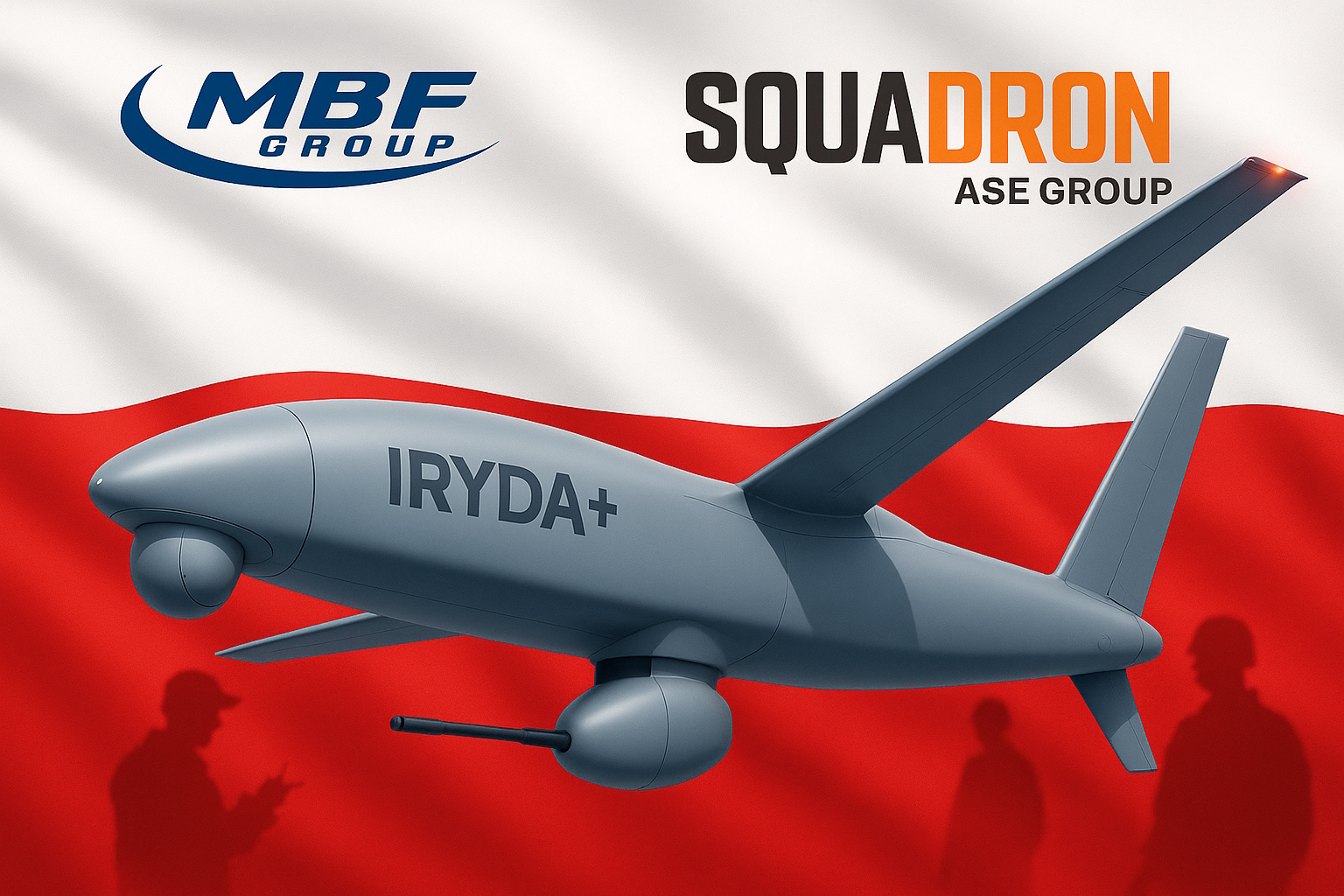
Na pomysł opracowania takiego drona wpadła firma Squadron Sp. z o.o. z Gdańska, która utworzyła w tym celu wspólne konsorcjum z warszawską firmą wielobranżową MBF Group S.A., zapewniającą finansowanie programu. Ta pierwsza zapewnia potencjał projektowy i technologiczny, a drugą zajmuje się logistyką projektu. Trzecim zaangażowanym podmiotem jest Polskie Lobby Przemysłowe im. Eugeniusza Kwiatkowskiego z Warszawy, które ma zajmować się kwestią promowania projektu wykorzystując swoje kontakty i możliwości na polu medialnym.
Istotą aparatu z napędem spalinowym jest możliwość długotrwałego dyżurowania w powietrzu, a operator może skierować Irydę+ w kierunku nadlatującego drona szturmowego i zbliżyć się do niego. Sam proces zwalczania ma być realizowany za pomocą podkładłubowej wieżyczki strzeleckiej z karabinem maszynowym kal. 7,62 mm. Wieżyczka ma być sterowana w zakresie 360o w całej dolnej półsferze. Aparat ma mieć skrzydło proste o umiarkowanej rozpiętości oraz usterzenie podwójne (w układzie litery „H”), czyli z dwoma statecznikami pionowymi na końcach statecznika poziomego. Silnik ma być umieszczony z tyłu i napędzać śmigło pchające. Typ i moc silnika nie został jeszcze wybrany. Aparat ma mieć 3-3,5 m długości i 2,5-3 m rozpiętości. Masa aparatu ma wynieść około 150 kg, a udźwig to 15-20 kg. Ponieważ pokazana makieta drona nie ma podwozia więc należy przypuszczać że start ma nastąpić z katapulty, zaś lądowanie ma być realizowane albo za pomocą spadochronu, albo poprzez głębokie przeciągnięcie.
Pierwsze loty próbne samego płatowca mają być wykonane w 2026 r. Mają one sprawdzić własności lotne samego płatowca, jego sterowanie, nawigowanie oraz możliwość powrotu we właściwe miejsce. Długotrwałość lotu ma wynieść 8-10 godzin, zaś prędkość przelotowa w strefie dyżurowania ma wynieść 180-200 km/h, natomiast prędkość maksymalna w trakcie pościgu ma wynieść 250-280 km/h. Pułap jest określany jako „małe i średnie wysokości”, bo na takich właśnie operują drony dalekiego zasięgu, które mają być zwalczane.
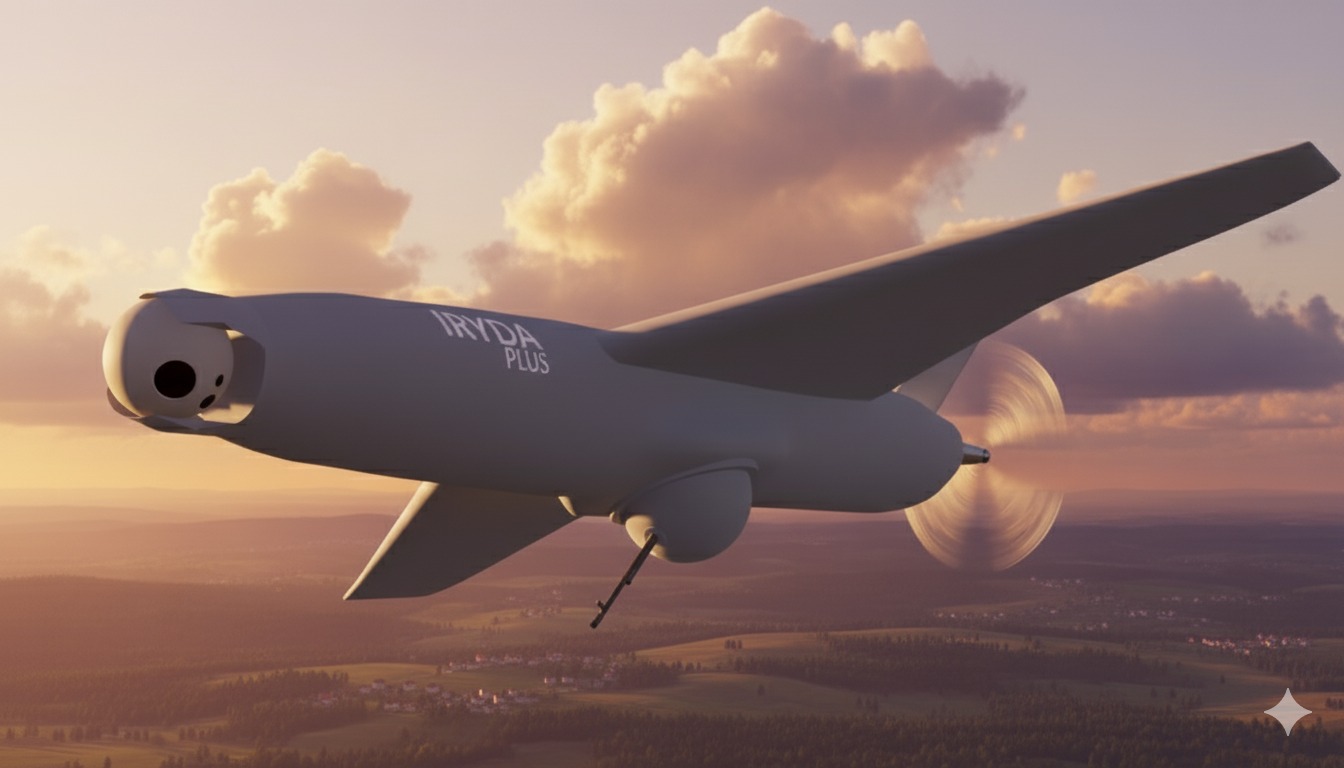
Sam proces przechwycenia ma wyglądać w ten sposób, że Iryda+ będzie kierowana w stronę nadlatującego drona uderzeniowego. Następnie ma odszukać go własną głowicą elektrooptyczną z wykorzystaniem kamery telewizyjnej lub termowizyjnej, a sam proces identyfikacji i przejścia na śledzenie ma być wspomagana sztuczną inteligencją. Po zbliżeniu się na odpowiednią odległość, na cel przez autonomiczny układ pokładowy znany jako TAS (Target–Aim–Shot) obserwując zwalczany obiekt przez kamerę ma naprowadzić na cel karabin maszynowy, odłożyć odpowiednie poprawki i otworzyć ogień. Po zniszczeniu celu, jeśli pozwoli na to zapas paliwa i amunicji, aparat ma wrócić do dyżurowania, czekając na kolejny cel.
W kolejnym roku prób planowanym na 2027 r. ma nastąpić integracja z aparatem głowicy elektrooptycznej oraz stanowiska strzeleckiego. Mają być prowadzone testy „na sucho”, bez realnego strzelania, zaś ocena poprawności celowania ma być prowadzona przez analizę zarejestrowanych parametrów. I wreszcie w trzecim roku, 2028, mają być przeprowadzone realne strzelania do celów powietrznych oraz mają być wykonane kompleksowe misje od startu przez przechwycenie do zestrzelenia celu powietrznego, a następnie powrót i lądowanie. Jeśli wszystko będzie działać dobrze, do z początkiem 2029 r. będzie można system wprowadzić do uzbrojenia. I to może być rozwiązanie problemu tanich dronów, choć czas rozwoju systemu jest niestety dość rozciągnięty w czasie.
Michał Fiszer, współpraca Maciej Herman
The Kick-off Meeting for the ECDI (European Cluster for Drone Innovation) project was held on November 20, 2025, bringing together all European partners around a common goal: to accelerate innovation and build a sustainable drone ecosystem in Europe.
It is a new Euroclusters-generation initiative led by:
🇫🇷 Aerospace Valley (Coordinator)
🇪🇸 ANDALUCÍA AEROSPACE Cluster Empresarial (Environment)
🇵🇱 Silesian Aviation Cluster (Communication & Network)
🇺🇦 All-Ukrainian Association of Innovative Space Clusters (Dual-use)
One of the project’s main objectives is to design three open calls dedicated to European SMEs operating in the drone sector, whether for civil or dual-use applications.
These initiatives will aim to:
- encourage technological innovation,
- support high-potential projects,
- strengthen European value chains and industrial capabilities.
These initial discussions have laid the foundations for a program aligned with the needs of the sector and European priorities in terms of technological sovereignty.
Towards the creation of an Innovation Drone Alliance
Another central pillar of the ECDI project is the establishment of the Innovation Drone Alliance, a new collaborative structure designed to bring together players in the drone industry in Europe.
This alliance will aim to:
- facilitate cross-sector cooperation,
- encourage the sharing of expertise,
- strengthen the sector’s competitiveness at the European level.
This kick-off marks the beginning of a structured international collaboration, which will pave the way for numerous operational actions in the coming months.
See you soon to discover the first advances of the ECDI project!
Combat operations in Ukraine continue to see new developments in the field of UAV use. Apart from the fact that UAVs introduced three months ago are becoming obsolete and require modifications to their navigation, communication, and warhead systems, brand-new designs and new areas of application for UAVs are also emerging.
One interesting development, as reported by a Ukrainian specialist in radio and electronics technologies, going by the pseudonym Serhiy Flash, is that the Russians have begun installing rear cameras in their Orlan and similar reconnaissance aircraft. These are very popular devices used for observing the battlefield and close rear areas, correcting artillery fire, and searching for targets for drone strikes. These rear-mounted cameras are used to protect drones from Ukrainian UAV interceptors. The Russians are experiencing increasing losses to their aircraft caused by cheap and increasingly popular lightweight, electric-powered UAV interceptors. Interceptor drones typically approach from behind, often slightly overhead, to calmly attack a Russian aircraft flying in a straight line, as the operator of an Orlan or similar system is unaware of the approaching threat. Now that they have a rear camera and can spot the approaching interceptor, the operator can maneuver the Orlan, making it difficult or even impossible for the Ukrainian interceptor to hit it. Interceptors typically have a short range of action, and if they are “outmatched” in maneuvers, they will be unable to renew their attacks.
Another innovation has appeared in the Ukrainian 413th Independent Unmanned Aerial System Battalion “Rejd.” This unit is subordinate to the Ukrainian Unmanned Aerial System Troops, and although its deployment is determined by the operational chain of command of the Ukrainian military, it does provide these units with a certain degree of freedom of action to independently search for and engage selected targets. The German company Quantum Systems, based in Munich, has delivered its new loitering munitions to this battalion: attack, disposable, unmanned aerial systems, known by the media as “kamikaze drones.” These are Stark Defense Virtus drones. This relatively large, unmanned aerial vehicle weighing approximately 30 kg can fly up to 100 km and attack a target designated by the operator, striking it with a 5 kg penetrating warhead containing approximately 2.5 kg of explosive material. This is more than half the charge of a 152-155 mm howitzer projectile, meaning the explosion is quite powerful, and a precise hit ensures the desired effect. The device launches vertically, so it does not require any launchers. Preparation for launch involves lifting it from the transport vehicle, positioning it at the launch site, and releasing it for flight, which takes several minutes. Afterward, the crew can leave the site and hide. The drone is, of course, controlled from a separate location, well-camouflaged to prevent the command center from becoming a target of an enemy attack.
The aforementioned 413th Battalion already operated Quantum Systems’ Vector reconnaissance unmanned systems with a similar range. They are now used to search for and designate targets for strikes for Stark Defense Virtus, as well as to film the aftermath of an attack.
A Stark Defense Virtus unmanned attack aircraft prepared for launch.
Of course, the use of lightweight aircraft with such a range, which lack satellite communications systems, requires the use of a flying communications relay. Such a vehicle, called a “mother bee” (a reference to the term “drone”), has equipment to relay communications between an operator on the ground and a vehicle performing a combat mission far above hostile territory, flying over friendly territory at a higher altitude.
The RAM-2X drone, manufactured in Ukraine, is to some extent a copy of the similar Russian ZALA Lancet system.
But this isn’t the only new type of extended-range loitering munitions that Ukrainian forces have begun using. At the same time, Ukraine has also begun using its own relatively cheap and highly effective RAM-2X drones, which are, to some extent, a copy of the Russian Lancet loitering munitions. The Ukrainian version, however, has a range of 150 km, greater than the original Lancet, of course using a flying radio transmitter. Recently, several successful strikes have been recorded against targets in occupied territories, as well as in Russia, within a range of approximately 70 km of areas controlled by Ukrainian troops. The introduction of these two types of loitering munitions could explain this, although we still don’t know whether these two types are the only ones with such range that have recently entered service.
Michał Fiszer, with Maciej Herman
We are pleased to announce that the 6th edition of the Silesian Aviation and Drone Days, one of the most significant events in the industry, will take place this year.
The upcoming edition will be held on Wednesday, June 11, 2025, at 9:00 AM, in the modern facility of BCU Skyport in Katowice. The Skyport Sectoral Skills Center is an innovative educational institution established to support the development of cutting-edge technologies in aviation.
This center was created through a collaboration between representatives of the academic and business sectors and consists of three key partners:
Vocational Training Center in Katowice – leader
Silesian Aviation Cluster – business partner
Silesian University of Technology, Faculty of Transport and Aviation Engineering – academic partner
This year’s event will feature a series of discussions and analyses that, in previous editions, focused mainly on light civil aviation and drone systems. In 2025, the scope will be broadened to include the military dimension, with invited experts presenting the aviation and drone industries as one of the leading dual-use technology sectors.
Participation in the event is free of charge.
Registration is available at the following link: https://app.evenea.pl/event/886506-6/
Event address: Z. Krasińskiego 2, 40-952 Katowice
We also warmly encourage companies and institutions to explore partnership opportunities, including active participation in one of the discussion panels. For details, please contact: gabriela.ryczek@aerosilesia.eu
We look forward to welcoming you to this unique event.
Silesian Aviation Cluster is organizing an event entitled “A conference dedicated to representatives of the aviation, drone, and space industries,” which will take place on December 8, 2023, in Kaniów.
December 8, 2023
Venue: Stefana Kóski 43, 43-512 Kaniów
Organized as part of the project entitled “Developing the potential of the Silesian Aviation Cluster by expanding its offer of innovative products and services offered to cluster members.” This event is part of the Smart Growth Operational Programme. Priority Axis 2: Supporting the environment and potential of enterprises to conduct R&D&I activities, Measure 2.3: Pro-innovation services for enterprises, Sub-Measure 2.3.7: Developing the potential of coordinators of Key National Clusters.
One of the main topics discussed during the event will be the drone industry, particularly the benefits and opportunities presented by future drone applications.
The aviation industry, and particularly the design and production of unmanned aerial vehicles (UAVs), has enormous economic potential that is worth developing, as this field offers significant opportunities for global success. This provides opportunities for collaborative action and joining forces to gain a competitive advantage in both domestic and international markets. Engagement in the development of UAVs offers significant growth opportunities for small and medium-sized enterprises. This year’s event aims to establish and strengthen cooperation between representatives of companies and entities operating in one of the most innovative sectors of the global economy: the aviation and drone industries.
During the conference, we will discuss how our platform supports the development of the Polish drone sector by integrating businesses, research institutions, and public institutions.
https://app.evenea.pl/event/886506-4
The 5th edition of the Silesian Aviation and Drone Days will be held on November 24, 2023. “Economic development and promotion of the Silesian Voivodeship through the aviation and drone industry”.
Previous editions of our event shed light on the key role of aviation and drone technology in building the economic power of Silesia, a concrete contribution to the developing region.
Follow our social media, where we will keep you updated on all the details of the upcoming conference.
*The event was co-financed from the budget of the Silesian Voivodeship Government.
Subscribe to our newsletter
Stay updated with all the news and offers